IFAS News
Institute of Food and Agricultural Sciences - University of Florida
Archive for March, 2009
Fern Gene Reduces Arsenic in Model Plant; Could Make Rice Safer, UF Expert Says
March 25, 2009
Topic(s): Agriculture, Biocontrols, Pollution, Safety

Caption at bottom of page. Click here for high resolution.
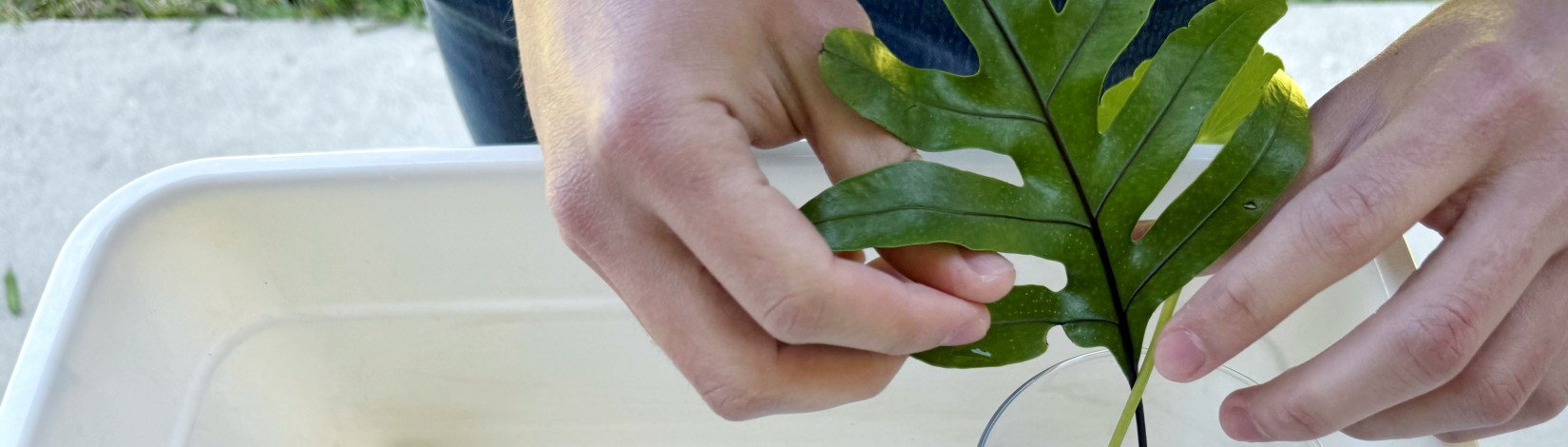
GAINESVILLE, Fla. — The Chinese brake fern accumulates huge quantities of arsenic, but one of its genes caused a model plant to do just the opposite, a discovery that surprised University of Florida scientists and could lead to low-arsenic rice varieties.
A UF study, published online this week in the journal Plant, Cell and Environment, showed that when mouse-ear cress plants with the added gene were grown in arsenic-laden soil, their leaves contained as little as one-seventh the arsenic of control plants. (more…)
Bees (stand alone photo - no story available)
March 20, 2009
Topic(s): Entomology and Nematology, Stand-Alone Photos, Uncategorized
- By:
Mickie Anderson - (352) 273-3566
In this photo released from the University of Florida’s Institute of Food and Agricultural Sciences, David Barnes, an apiary inspector with the Florida Department of Agriculture and Consumer Services, shows participants in the 2009 Bee College how to safely conduct a bee colony inspection – Friday, March 20, 2009. (more…)
More Floridians Ready to Grow Their Own Groceries, IFAS Experts Say
March 17, 2009
Topic(s): Agriculture, Crops, Economics, Extension, Families and Consumers, Finances, Vegetables
- By:
Mickie Anderson - (352) 273-3566 - Source:
Sydney Park Brown - spbrown@ufl.edu, (813) 757-2286
GAINESVILLE, Fla. — With the nation’s economy withering, University of Florida experts say many state residents are looking to put food on the table - by growing it.
Sydney Park Brown, a UF extension specialist with the Institute of Food and Agricultural Sciences, said extension agents around the state have noticed a big uptick in interest about vegetable gardening. (more…)
Many Turning to Home Gardening - Minus the Dirt
March 17, 2009
Topic(s): Agriculture, Crops, Economics, Extension, Families and Consumers, Finances, RECs, Vegetables
- By:
Stu Hutson - (352) 273-3569 - Source:
Bob Hochmuth - bobhoch@ufl.edu, (386) 362-1725
GAINESVILLE, Fla. — Today’s economically spurred resurgence of the home vegetable grower can’t entirely be dubbed a "return to the earth." Many burgeoning farmers aren’t breaking soil, they’re using hydroponics.
"There are a lot of new people interested in growing, and many of them are realizing that hydroponics just makes a lot more sense," said Bob Hochmuth, a multicounty agent with the University of Florida’s Institute of Food and Agricultural Sciences. "It’s one of the most reliable ways to grow crops. And, for people that don’t have a lot of land, which I think is a lot of these new growers, it’s a more cost-effective investment." (more…)
UF Extension Agents Give Advice on Dealing with Unwanted Pets
March 17, 2009
Topic(s): Families and Consumers
- By:
Mickie Anderson - (352) 273-3566 - Sources:
Maia McGuire - mpmcg@ufl.edu, (386) 437-7464
Eleanor Foerste - efoerste@ufl.edu, (321) 697-3000
GAINESVILLE, Fla. — For some, turning an unwanted pet loose may seem the only thing to do, but University of Florida extension agents are working to get out the message that it can be dangerous for the animal - and disastrous for the environment.
With a slew of invasive creatures - everything from monkeys to pythons - wreaking havoc throughout Florida’s terrestrial, freshwater and marine ecosystems, three Institute of Food and Agriculture Sciences experts put their heads together to find a way to help put a dent in the problem. (more…)
UF Scientists: New Genetic Analysis Method May Unlock Secrets of Nematode Populations
March 12, 2009
Topic(s): New Technology, Research
- By:
Tom Nordlie - (352) 273-3567 - Sources:
Robin Giblin-Davis - giblin@ufl.edu, (954) 577-6333
Dorota Porazinska - dorotalp@ufl.edu
GAINESVILLE, Fla. — Nematodes may be the most abundant creatures on Earth, but analyzing communities of the wormlike animals is difficult because they’re microscopic and many species look alike.
Computer-assisted genetic analysis could change that, say University of Florida scientists who have completed a demonstration study of a new method. It was published online this month in the journal Molecular Ecology Resources. (more…)