IFAS News

University of Florida

IFAS News RSS Feed

UF/IFAS experts find feral hog control efforts often fail, now investigating why

Topic(s): Agriculture, Environment, Forestry, Invasive Species, Livestock, Pests

Cutline at bottom. Click here for high-resolution image.

GAINESVILLE, Fla. — Feral hogs wreak havoc on Florida’s natural areas but a new University of Florida study shows that control measures often fail; now, researchers are investigating how the animals outwit removal efforts.

“Feral hogs are definitely one of our more noticeable invasive animal issues on the Treasure Coast,” said Ken Gioeli, a St. Lucie County extension agent. “People have been struggling to deal with the populations and we want to offer them better options.”

The study appears in the summer issue of the journal Aquatics, a publication of the Florida Aquatic Plant Management Society.

Florida has the nation’s second-highest population of feral hogs, after Texas. The animals are especially common north and west of Lake Okeechobee, and in the coastal Big Bend area, Gioeli said. They roam in groups and damage forest ecosystems by rooting in the soil and wallowing in shallow water. It’s believed that feral hog damage costs landowners and agricultural producers millions of dollars nationwide.

(more …)

UF/IFAS creates math-based model to show how citrus greening spreads within tree

Topic(s): Citrus, Pests, RECs, Research

GAINESVILLE, Fla. — University of Florida researchers have created a mathematical model that shows how citrus greening is transmitted within an infected tree – an important step toward helping scientists understand the devastating disease.

The model, published this month by the journal Proceedings of the National Academy of Sciences, revealed that once a tree is infected, insecticides to control the pests that spread the disease may not be enough to halt the disease’s progression in the tree, and instead may only slow its spread within the tree.

(more …)

UF/IFAS study suggests growers should monitor for tomato thrips carefully

Topic(s): Agriculture, Crops, Environment, Invasive Species, Pests

GAINESVILLE, Fla. — South Florida vegetable growers worried about the invasive tomato thrips should make certain they’re looking for the pest in the right places, say University of Florida researchers.

Also known as common blossom thrips, the species is native to South America and attacks a variety of crops. A major pest of tomatoes and cucumbers in its home range, the thrips has been detected regularly in South Florida since 2008.

A team from UF’s Tropical Research and Education Center in Homestead recently published a study outlining their efforts to assess the abundance and distribution of tomato thrips in cucumber fields. Their findings appear in the June 2012 issue of the journal Bulletin of Entomological Research.

(more …)

UF researchers find natural product that boosts plant defense against root pests

Topic(s): Agriculture, Biocontrols, Citrus, Environment, IFAS, New Technology, Pests, RECs, Research

Beneficial nematodes emerging from insect.

Click here for high resolution photo. Caption at bottom.

GAINESVILLE, Fla. — University of Florida researchers have discovered a natural compound to battle insect pests that plague gardeners and growers.

The compound boosts crops’ resistance to pest attacks on their roots by recruiting microscopic worms that kill the insects by eating them from the inside out.

Researchers, including members of UF’s Institute of Food and Agricultural Sciences, made the discovery by studying chemicals released by citrus roots when they are attacked by citrus root weevil larvae. Their results are published in the June 27 edition of the online journal PLoS ONE. (more …)

UF/IFAS study shows how diet affects lab-raised mosquitoes in medical studies

Topic(s): Entomology and Nematology, Household Pests, Pests, Research

GAINESVILLE, Fla. — Most people try to avoid feeding hungry mosquitoes, but for some medical researchers it’s a different story.

Lab-raised mosquitoes are used in studies investigating how the blood-sucking insects transmit viruses and parasites. Those mosquitoes must be cared for and that means providing female specimens with blood, which supplies protein they need to produce eggs.

Some labs allow their mosquitoes to feed the old-fashioned way, by biting live animals. But to save time, money and effort, other labs give the insects packaged animal blood, which may contain additives or lack components removed by processing.

Scientists with the University of Florida’s Institute of Food and Agricultural Sciences have found that different types of blood influence the quantity of eggs a female mosquito produces, and the likelihood those eggs hatch.

That’s important to know, because mosquito researchers typically want to know how closely their lab experiments mimic real-world conditions.

The study, conducted at UF’s Florida Medical Entomology Laboratory in Vero Beach, was published in the June issue of Journal of Vector Ecology.

To feed the mosquitoes, scientists used four blood sources: live chickens, chicken blood with an anticoagulant added, beef blood with an anticoagulant added, and beef blood with its main clotting protein removed. Female mosquitoes were divided into groups and most groups were offered only one blood source throughout the study.

One example of the variability the scientists found: Among mosquitoes offered beef blood without the clotting protein, only 31 percent chose to feed; among those that fed, 40 percent laid eggs and 70 percent of those eggs hatched. In contrast, 61 percent of the mosquitoes offered a live chicken chose to feed, 46 percent of those that fed laid eggs, and 83 percent of those eggs hatched.

Lead author Stephanie Richards, now an assistant professor at East Carolina University, said the results show that mosquito researchers should carefully consider feeding methods when designing experiments. She also suggests more research might be needed to determine whether different blood sources may affect mosquitoes’ ability to transmit viruses.

Contacts

Writer:  Tom Nordlie, 352-273-3567, tnordlie@ufl.edu

Source: Stephanie Richards, 252-328-2526, richardss@ecu.edu


UF/IFAS dedicates conference center at Plant Science Research and Education Unit in Citra

Topic(s): Agriculture, Announcements, Citrus, Crops, Cultivars, IFAS, New Technology, Pests, Research

GAINESVILLE, Fla. — Since 2000, the University of Florida’s Plant Science Research and Education Unit in Citra has been “an idea place” where new crops and production techniques are tested.

Now, it’s a place where new ideas can be communicated to UF faculty, students and guests much more easily.

At a May 15 ceremony attended by several hundred guests, UF officials dedicated the unit’s new 12,000 square-foot conference center, the Frank Stronach Plant Science Center, named for the donor who funded the building project.

“Today, we gather to dedicate more than a building—it’s an idea place,” said Jack Payne, UF senior vice president for agriculture and natural resources.

That sentiment was echoed by several other speakers, including UF President Bernie Machen, who noted that many of the crop varieties developed by UF plant breeders get their first real-world field trials at the unit.

Though the 1,068-acre unit has always had plenty of room for cultivating plants, it’s only now that there’s enough teaching space, said Danny Colvin, the unit’s director.

(more …)

UF/IFAS research looks at impact on honeybees from chemicals and mites

Topic(s): Entomology and Nematology, Pests

GAINESVILLE, Fla. — University of Florida honeybee researcher Jamie Ellis is interested in what happens to bees that encounter chemicals and Varroa mites — but he’s even more interested in how younger bees fare long-term after facing those challenges.

Scientists have been trying to explain the bee-killing malady known as Colony Collapse Disorder, which causes honeybees to abandon their hives, become ill and die. Ellis’ lab has been studying how combinations of environmental factors — chemicals, pathogens, natural enemies — affect bees.

(more …)

Tussock moth cocoons cause allergic reactions in some, UF expert says

Topic(s): Green Living, Household Pests, Pests


Click here for high-res image

Caption below

GAINESVILLE, Fla. — Florida’s poison-control centers recently noted an uptick in calls about stinging caterpillars, and now a University of Florida entomologist warns that some people may suffer skin irritation from cocoons that are unusually abundant this year.

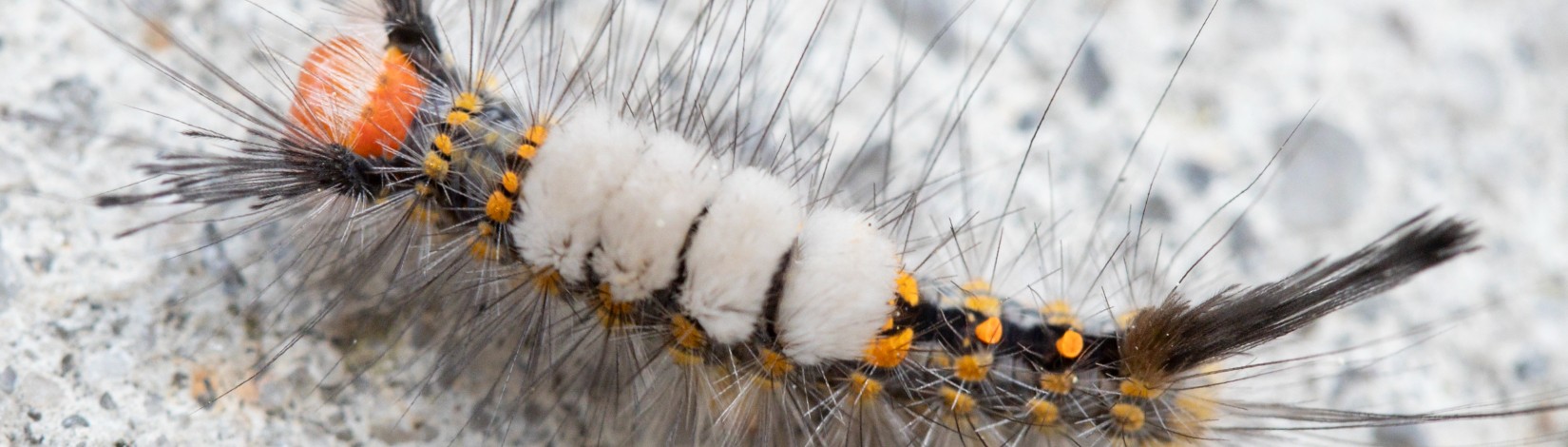
The culprit is a tussock moth, known scientifically as Orgyia detrita. Its caterpillars are usually active in March and April, often in the vicinity of oak trees. Touching the furry, black-and-white critters can cause localized swelling, itching, burning and redness. The caterpillar doesn’t produce stinging venom, but its hairs trigger an allergic reaction in some people.

(more …)

Citrus greening bacterium may “ring the dinner bell” to attract insect

Topic(s): Agriculture, Citrus, Crops, Entomology and Nematology, Environment, IFAS, Invasive Species, Pests

Cutline at bottom. Click here for high-resolution image.

The bacterium responsible for citrus greening causes infected trees to give off a scent that rings the dinner bell for the disease-carrying insect, University of Florida researchers say.

This finding might distress growers, but it could enable scientists to better monitor the insect and maybe cut the chances healthy trees become infected.

The study was published online March 22 by the journal PLoS Pathogens. The article, which is open access, is at http://dx.plos.org/10.1371/journal.ppat.1002610

Greening-infected citrus trees emit a fragrant chemical called methyl salicylate, said study author Lukasz Stelinski, an assistant professor with UF’s Institute of Food and Agricultural Sciences. Citrus trees release the same chemical, in the same amount, when under attack by the Asian citrus psyllid, the insect that transmits the bacterium.

When the pests encounter a faint whiff of methyl salicylate they interpret it to mean that other psyllids have found a good place to feed, and hurry to join the banquet. One experiment in the study showed that psyllids were more likely to land on infected citrus trees than healthy ones.

(more …)

Color is key in controlling flies, UF researchers find

Topic(s): Entomology and Nematology, Environment, Household Pests, IFAS, Pests, Research, Safety

Florida Fly-Baiter

Caption at bottom. Click here for high resolution image.

Downloadable video is available at: http://dl.dropbox.com/u/10837916/20120215_FlyTrap.zip

GAINESVILLE, Fla. — As a carrier of as many as 100 types of germs, the common house fly is hardly as innocuous as its name might suggest.

Military personnel know this firsthand, and their need for effective fly control has helped University of Florida researchers create an innovative new fly control device.

Known as the Florida Fly-Baiter, the device is blue — in contrast to the yellow fly control devices on the market — and is far more effective, said Phil Koehler, a professor of urban entomology with UF’s Institute of Food and Agricultural Sciences.

(more …)

Back to Top