University of Florida

IFAS News

Institute of Food and Agricultural Sciences – University of Florida

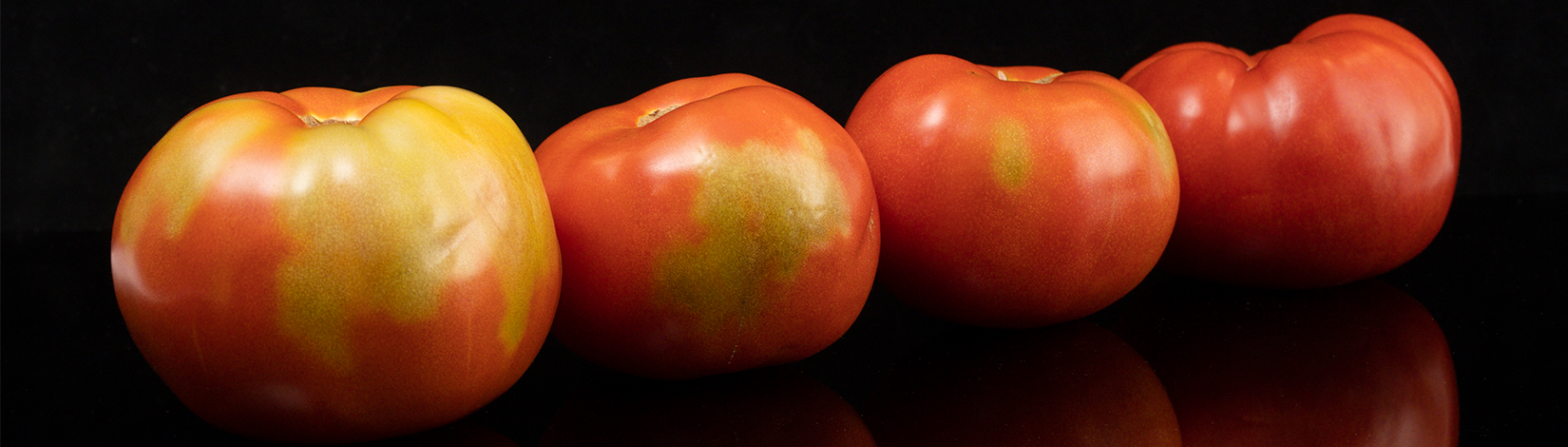
Under lab conditions, Salmonella can reach tomato fruits through leaves, IFAS study shows

November 10, 2011
Topic(s): Crops, Food Safety, Research

Caption at bottom. Click here for high-resolution image.

GAINESVILLE, Fla. — Food-safety experts have long believed that Salmonella bacteria could only enter tomatoes through wounds in the stem or fruit — but a new University of Florida laboratory study shows it can also happen another way.

Plant pathologist Ariena van Bruggen, a professor in UF’s Institute of Food and Agricultural Sciences, published a paper today in the online journal PLoS One, with research findings that show — for the first time — that Salmonella can enter tomato plants through intact leaves, travel through the plant and end up in the fruit itself. (more…)

UF researcher reduces allergens in peanuts using pulsed light

June 8, 2011
Topic(s): Departments, Food Safety, IFAS, New Technology, Research

Multimedia available: http://news.ufl.edu/2011/06/08/peanut-allergen-multimedia/

Cutline at bottom. Click here for high-resolution image.

GAINESVILLE, Fla. — A University of Florida researcher has developed a new technique to make peanuts safer for people with peanut allergies.

Wade Yang, an assistant professor in UF’s food science and human nutrition department, used pulsed ultraviolet light, or PUV, to reduce the allergenic potential of peanuts by up to 90 percent. The study was published this week by the journal Food and Bioprocess Technology.

By releasing pulsed, or concentrated, bursts of light containing multiple wavelengths, PUV changes peanut allergens so that human antibodies can’t recognize them and cause the release of histamines, which are responsible for allergy symptoms such as itching, rashes and wheezing.

“We believe the allergen can be controlled at the processing stage, before the product even goes to the shelf,” Yang said.

(more…)

UF research finds salmonella responds differently to tomato varieties, ripeness

September 23, 2010
Topic(s): Agriculture, Cultivars, Food Safety, Safety, Vegetables

Caption at the end of the story

Multimedia available: http://news.ufl.edu/2010/09/21/salmonella-multimedia/

GAINESVILLE, Fla. — University of Florida researchers have discovered that tomato variety and maturity influence the ways salmonella bacteria respond to the fruit.

The findings, published Aug. 31 by the online, open-access journal Public Library of Science (PLoS) ONE, suggest researchers may be able to develop tomato cultivars more resistant to salmonella contamination.

Also, by monitoring tomato ripeness, it may be possible to reduce fruit’s susceptibility to contamination during and after harvest, said Max Teplitski, an associate professor in soil microbiology. (more…)

UF discovers house flies carrying five new illness-causing bacteria

August 27, 2010
Topic(s): Entomology and Nematology, Food Safety, Household Pests

Cutline at bottom. Click here for high resolution image.

GAINESVILLE, Fla. — Everyone knows that house flies aren’t welcome around food.

But University of Florida scientists have discovered five new reasons why.

Researchers with UF’s Institute of Food and Agricultural Sciences have documented five more bacteria species carried by house flies, and all of them cause illness in humans, ranging from food poisoning to respiratory infections.

In the current issue of Florida Entomologist, the researchers describe collecting house flies near rear entrances and trash bins at four restaurants in Gainesville. About 20 flies from each location were collected in sterile containers and returned to the campus laboratory.

(more…)

UF Food Summit to showcase Florida food issues, sustainability

April 1, 2010
Topic(s): Agriculture, Food Safety, Green Living, Safety

The University of Florida Office of Sustainability will host the first Florida Food Summit April 12-13. The event at UF’s Reitz Student Union will facilitate networking, dialogue and visioning among members of the Florida food system. The summit will help develop the connections needed for robust farm-to-institution programs and is part of the Office of Sustainability’s “40 Days of Change” campaign – a celebration of the 40th anniversary of Earth Day.

The event will begin with a welcome reception, followed by discussion panels focusing on local food systems at the local and state level. Other events include film screenings, multimedia presentations, a “Food on the Lawn” fair and farmers market.

“Food on the Lawn” will take place on UF’s Plaza of the Americas from 11 a.m. to 3 p.m. April 12, featuring food demonstrations, educational displays and local produce for sale. A photography exhibition, “Range, Furrow, and Grove: Images of Florida Agriculture,” will also be on display April 5-17 in the Reitz Student Union Gallery. (more…)

Computer model reveals where food pathogens grow

December 3, 2009
Topic(s): Agriculture, Crops, Food Safety, New Technology

MANURE COMPOST

Caption at the bottom of the post. Click for full image.

GAINESVILLE, Fla. — An outbreak of food-related illness, such as E. coli-tainted spinach, often leaves food safety experts scratching their heads over the source of the contamination.

Thanks to a new computer model developed by researchers at the University of Florida, Wageningen University and the University of Groningen in the Netherlands, food safety experts may have a better chance of predicting where contamination risks lie and what can be done to minimize those risks.

The program, dubbed COLIWAVE, can predict the growth and death of pathogenic bacteria in substances like compost, soil and water. The program uses variables such as oxygen availability, temperature and substance characteristics to predict how much bacteria is present at different periods of time.

(more…)

Goodbye “R” rule? Oyster pathogen test may help make shellfish safer

October 14, 2009
Topic(s): Aquaculture, Food Safety, New Technology, Research, Uncategorized

Oyster Research

Caption at bottom of page. Click for full image.

The oyster lover’s axiom of edibility — that this shellfish is safest to eat in any month with an “r” in it — may soon become somewhat of a culinary anachronism, thanks to a new food-safety test developed with help from the University of Florida.

Oysters are typically considered safest to eat in cooler months (September through April) because the shellfish-infecting bacteria in the genus Vibrio flourish best in warm temperatures.

Even in the “r” months, slurping an oyster opens some people to infection from these bacteria, which can cause fever, nausea, abdominal pain, diarrhea and has even led to finger amputation when it’s given a chance to penetrate a cut or skin lesion.

However, a new quick and inexpensive diagnostic test developed by DuPont Qualicon and refined by UF’s Institute of Food and Agricultural Sciences could make weeding out pathogen-loaded oysters much more practical and efficient. Oysters are a $14 million industry in the Sunshine State, according to the Department of Agriculture and Consumer Services.

(more…)

NSF awards $1.4 million to UF, other institutions to study disease threatening lobsters

October 7, 2009
Topic(s): Aquaculture, Biocontrols, Conservation, Food Safety

lobster_two

Caption at bottom. Click here for full image.

The Caribbean spiny lobster is one of Florida’s top commercial seafood species, with an annual $27 million harvest — but a recently discovered virus is killing the crustaceans and threatening the industry.

Now, scientists with the University of Florida and several other institutions have been awarded a three-year, $1.4 million National Science Foundation grant to research transmission of the virus, known as PaV1.

The research should answer many lingering questions about the spread and geographic distribution of the pathogen, and could lead to management strategies and new methods for identifying infected lobsters, said Don Behringer, an assistant professor with UF’s Institute of Food and Agricultural Sciences.

One of the main issues to be investigated: whether the virus is dispersed long distances by lobster larvae, which float hundreds of miles during their first months. Infected spiny lobsters have been found in far-flung places, including the Florida Keys and parts of Mexico, Belize and St. Croix. (more…)

Native holly can provide caffeinated, antioxidant-rich beverage, UF experts say

June 25, 2009
Topic(s): Food Safety, Nutrition

yaupontea

Caption at bottom. Click here for high resolution image.

GAINESVILLE, Fla. — Coffee and tea drinkers, take note — a University of Florida study says a beverage made from a native holly tree might be just the thing to give you a caffeinated kick-start, plus a dose of antioxidants.

Yaupon (YO-ponn) holly is the only U.S. plant that produces substantial amounts of caffeine, said Jack Putz, a botany professor affiliated with UF’s Institute of Food and Agricultural Sciences. A popular ornamental species, yaupon grows wild throughout the Southeast and can be grown in most coastal states.

Centuries ago, American Indians and Spanish settlers steeped yaupon leaves and twigs in hot water to make a stimulating beverage, but that use of the plant is virtually unknown today.

(more…)

UF food scientists call for new science in food safety

May 19, 2009
Topic(s): Biocontrols, Crops, Food Safety, New Technology, Vegetables

GAINESVILLE, Fla. — Some University of Florida food scientists say U.S. food safety procedures need to get out of the 1960s and into the era of biotechnology.

Back then, America’s scientists devised a system to ensure astronauts’ food stayed safe. That system, called Hazard Analysis of Critical Point, became the U.S. industry standard.

HACCP (pronounced “hassip”) is largely based on choosing points during handling and processing to eliminate or reduce as many possible hazards from food. While the method has given America an unparalleled level of food safety, there are new options to explore.

Featuring articles from UF’s Institute of Food and Agricultural Sciences, the new issue of the Journal of Current Opinion in Biotechnology focuses on applying recent scientific discoveries to food safety.

“We have to look at everything we know about the whole system,” said microbiologist Max Teplitski, who co-authored the journal’s lead editorial with food scientist Anita Wright. “And we know a lot more than we knew half a century ago. Recent food safety scares have shown us that maybe it’s time we started applying that knowledge.”

Topics such as biofilms and some aspects of genetics research are so new that they haven’t had time to be used in food safety systems, or need more study. Others, such as probiotics and stress-resistant bacteria, are slowly being integrated.

(more…)

Next Page »

Archives